
Buying property in India is a major milestone for many people, whether it is a family home, an investment, or an inherited asset. However, property ownership involves much more than paying the purchase price and receiving possession. Buyers must understand legal rights, ownership documents, registration procedures, taxes, and verification requirements. A single mistake during the process can result in disputes, financial losses, or fraud.
India’s real estate sector has become more transparent with reforms such as the Real Estate (Regulation and Development) Act (RERA), digital land records, and stricter registration systems. In 2026, increased focus on ownership verification, biometric registration, and fraud prevention has made due diligence more important than ever. As a result, buyers need to verify property titles, ownership history, approvals, and legal records before making any purchase decision.
Whether you are buying your first apartment, investing in land, purchasing a rental property, or inheriting family assets, understanding property ownership is essential. Think of it as following traffic rules while driving-when you understand the process and legal requirements, the journey is smoother and safer. This guide explains the key aspects of property ownership in India, helping you make informed decisions and protect your investment.
Table of Contents
Understanding Property Ownership in India
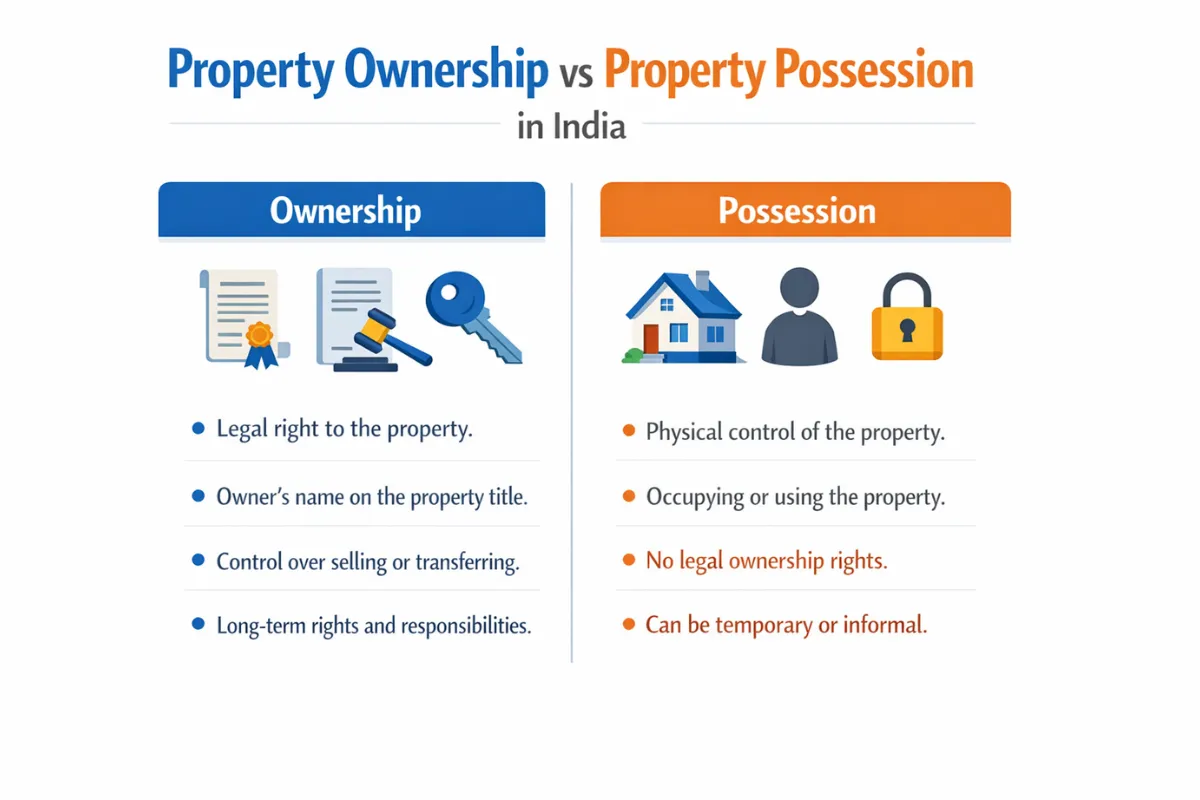
What Property Ownership Means
Property ownership is the legal right to own, use, sell, lease, transfer, or inherit a property under Indian law. It applies to land, houses, apartments, and commercial properties. Legal ownership is established through documents such as the sale deed, title deed, mutation records, and property tax receipts. Simply occupying a property does not make a person the legal owner.
Why Property Ownership Matters for Buyers and Investors
Property ownership provides financial security, long-term wealth creation, and legal protection. Owners can earn rental income, obtain loans against property, and transfer assets to heirs. This makes real estate a preferred investment for many buyers.
Difference Between Ownership and Possession
Ownership and possession are different concepts. Possession means physically occupying a property, while ownership refers to legally recognized rights. For example, a tenant may possess a house but does not own it. Legal ownership is valid only after proper registration and verification of ownership documents.
Types of Property Ownership in India
Property ownership in India is classified into different legal categories based on ownership rights and the number of owners. Understanding these types is important because they influence inheritance, taxation, resale rights, and financial responsibilities. Selecting the right ownership structure helps prevent disputes and ensures smoother property transactions.
Sole Ownership
Sole ownership means a property is owned by one individual who has complete authority to sell, lease, transfer, or modify it. This ownership structure provides complete control over the property, streamlined documentation, and easier access to home financing, making it a preferred option for many buyers.
Joint Ownership
Joint ownership involves two or more people sharing ownership rights over a property. It is common among married couples, siblings, and business partners. Joint ownership helps reduce financial burden and improves home loan eligibility when co-owners apply together.
| Ownership Type | Meaning |
|---|---|
| Joint Tenancy | Equal ownership with survivorship rights |
| Tenancy in Common | Unequal ownership shares possible |
| Coparcenary Ownership | Hindu Undivided Family ownership structure |
Co-Ownership and Shared Ownership
Co-ownership allows multiple individuals to share ownership rights in the same property. Since property prices continue to rise in cities like Chennai and Hyderabad, shared ownership has become increasingly popular among families and investors.
Freehold vs Leasehold Property Ownership
| Feature | Freehold | Leasehold |
|---|---|---|
| Ownership Duration | Permanent | Limited Period |
| Land Ownership | Yes | No |
| Transfer Flexibility | High | Restricted |
| Market Value | Higher | Usually Lower |
Most buyers prefer freehold properties because they provide complete ownership rights and better long-term value.
Legal Rights and Responsibilities of Property Owners
Understanding property owner responsibilities is essential for maintaining legal compliance, protecting ownership rights, and avoiding financial or legal disputes related to real estate assets.
Rights to Sell, Lease, Transfer, and Inherit Property
A legal property owner has the right to sell, lease, transfer, mortgage, gift, or inherit property under Indian law. These rights are protected by regulations such as the Transfer of Property Act and the Registration Act, allowing owners to manage and transfer assets legally.
Property Tax and Maintenance Responsibilities
Property ownership comes with financial responsibilities. Owners must regularly pay:
- Property tax
- Water tax
- Maintenance charges
- Society fees
- Utility bills
Failure to pay these dues may result in penalties or legal complications. Buyers should verify outstanding payments before purchasing any property.
Legal Protection Against Property Disputes
Proper documentation is essential to avoid disputes. Property owners should maintain:
- Registered sale deed
- Mutation records
- Updated tax receipts
- Encumbrance certificate
- Approved building plans
Regulatory bodies such as RERA have further strengthened transparency and buyer protection in the real estate sector.
Essential Property Ownership Documents Every Buyer Should Verify
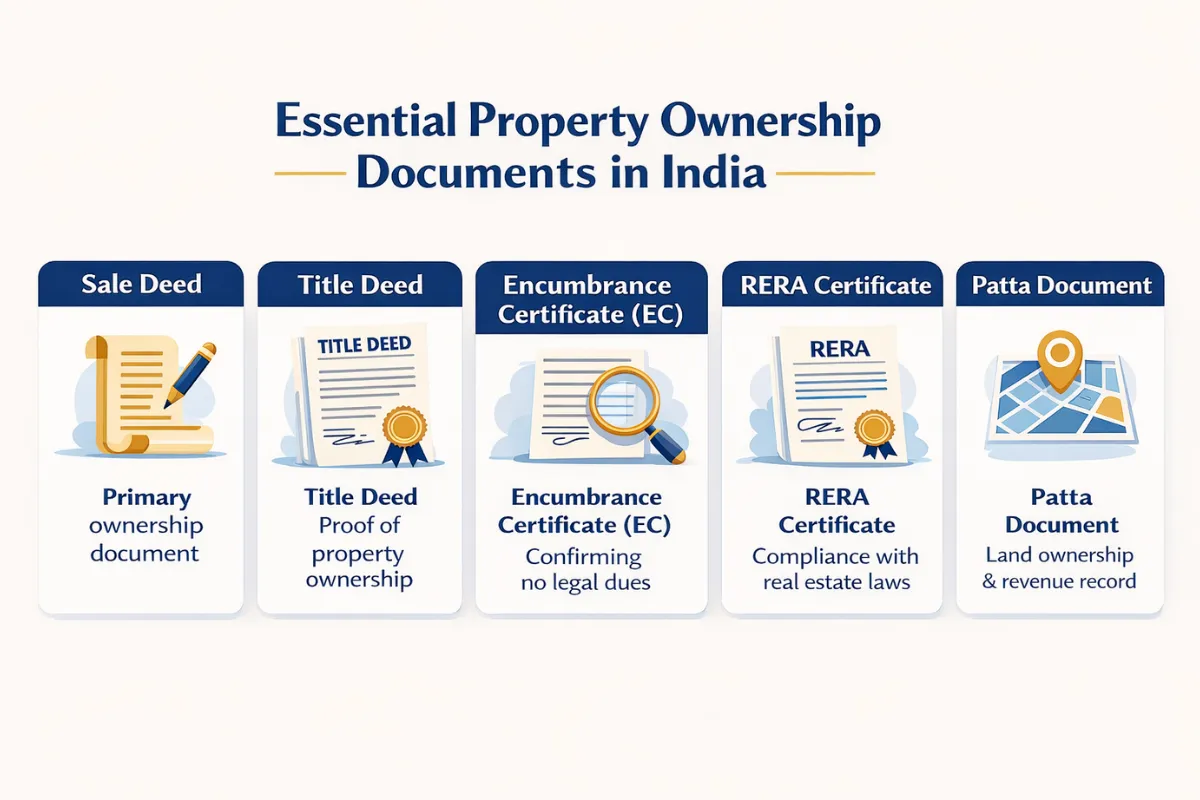
Before purchasing any property, buyers must carefully review all property legal documentation to verify ownership, ensure regulatory compliance, and avoid future disputes.
Sale Deed and Title Deed
- Sale Deed – The sale deed is the primary legal document that transfers property ownership from the seller to the buyer. Without proper registration, legal ownership remains incomplete.
- Title Deed – This document confirms the seller’s ownership rights and property history. Buyers should always verify that the property has a clear and marketable title before making payment.
Encumbrance Certificate and Property Tax Receipts
- Encumbrance Certificate (EC) – The EC confirms whether the property has existing loans, mortgages, or legal liabilities. It helps buyers avoid future financial disputes.
- Property Tax Receipts – Updated tax receipts prove ownership continuity and confirm that municipal taxes have been paid regularly.
Occupancy Certificate, Completion Certificate, and RERA Approval
For apartments and newly developed projects, buyers should verify:
- Occupancy Certificate (OC) – Confirms the building is safe and legally fit for occupancy.
- Completion Certificate (CC) – Shows the project was completed according to approved plans.
- RERA Registration – Verifies that the builder and project comply with regulations under Real Estate Regulatory Authority.
RERA registration has significantly enhanced transparency, accountability, and consumer protection in the Indian real estate sector.
Patta, Chitta, and Land Ownership Records
- Patta – Confirms lawful ownership of land.
- Chitta – Contains land classification and revenue details.
- Land Records Verification – Buyers in Chennai and other parts of Tamil Nadu should carefully verify these records through government portals and local authorities before purchase.
How to Verify Property Ownership Before Buying
Following essential property verification tips can help buyers confirm ownership authenticity, identify legal issues, and avoid costly real estate disputes before completing a purchase.
1. Checking Property Title and Ownership History
Buyers should verify the property title and ownership history, ideally covering the past 30 years. This helps confirm clear ownership and identify any disputes or claims.
Key documents to check include:
- Previous sale deeds
- Partition deeds
- Gift deeds
- Inheritance records
- Court litigation history
2. Verifying Builder or Seller Credentials
Before purchasing from a builder or developer, review their credibility and track record.
Verify:
- RERA registration
- Previous project delivery history
- Customer reviews and complaints
- Financial reputation
3. Checking Government Approvals and Legal Status
Ensure the property has all required approvals from local authorities.
Important approvals include:
- Building approvals
- Layout approvals
- Land conversion approvals
- Environmental clearances
4. Importance of Legal Verification by Property Lawyers
A property lawyer can identify risks such as fake documents, ownership disputes, encroachments, loan liabilities, and pending litigation before the purchase is completed.
Legal Checklist Before Buying Property in India
Buying property without legal verification can lead to disputes, fraud, and financial losses. A proper legal checklist helps buyers confirm ownership, approvals, and compliance before completing a transaction.
Check RERA Registration and Government Approvals
RERA registration is one of the most important checks for under-construction properties. It helps buyers verify project authenticity, builder credibility, and approved timelines while reducing the risk of fraud.
Verify:
- RERA registration status
- Builder details and completion timeline
- Approved building plans
- Environmental clearances
- Municipal approvals
Review Sale Agreement and Registration Documents
The sale agreement and ownership records establish the legal relationship between the buyer and seller. Reviewing these documents carefully helps ensure clear ownership and prevents future disputes.
Important documents include:
- Sale deed
- Mother deed
- Encumbrance certificate
- Possession certificate
- Registration records
- Property tax receipts
Verify Pending Legal Dues and Tax Payments
Outstanding dues can become the buyer’s responsibility after purchase. Verifying all payments in advance helps avoid unexpected financial liabilities.
Confirm that:
- Electricity bills are cleared
- Water tax is paid
- Property taxes are updated
- Maintenance dues are settled
- No active loan exists on the property
Confirm Land Use and Approval Status
Checking land classification and approval status ensures the property complies with local development regulations and can be used for its intended purpose without legal issues.
Check:
- Land classification
- CMDA/DTCP approval
- Building permit validity
- Floor plan approval
- Road access compliance
Property Registration and Ownership Transfer Process in India
Steps Involved in Property Registration
Step 1 – Verify Title & Documents
Check ownership records and property documents for clarity.
Step 2 – Pay Stamp Duty
Pay the required stamp duty as per property value.
Step 3 – Prepare Sale Deed
Draft and finalize the sale deed agreement.
Step 4 – Visit Sub-Registrar Office
Go to the local Sub-Registrar office for registration.
Step 5 – Biometric Verification & Signing
Verify identity and sign documents biometrically.
Step 6 – Collect Registered Document
Collect the officially registered property document.
Stamp Duty and Registration Charges in India
| State | Approx Stamp Duty + Registration |
|---|---|
| Tamil Nadu | Around 9% |
| Karnataka | 5% to 7% |
| Maharashtra | 6% to 7% |
| Telangana | Around 7% |
These charges vary by state and significantly affect the overall property cost.
Common Real Estate Frauds in India and Ways to Prevent Them
Property ownership can legally transfer through different methods, including:
- Sale deed
- Gift deed
- Will inheritance
- Relinquishment deed
Each transfer type has separate legal and tax implications.
Common Mistakes During Property Registration
Buyers should avoid common registration mistakes such as:
- Incorrect names
- Wrong survey numbers
- Unpaid stamp duty
- Missing witnesses
- Unregistered agreements
Even minor documentation errors can create serious legal complications in the future.
Common Real Estate Frauds in India and Ways to Prevent Them
Property fraud remains a major concern in India, with scams involving forged documents, fake approvals, and ownership disputes. Buyers should verify all records independently and avoid making decisions based solely on advertisements or sales promises.
Fake Property Documents and Forged Title Deeds
Forged title deeds are a common fraud where fake ownership documents are used to sell properties illegally. Buyers should carefully verify ownership records before making any payment.
Warning signs include:
- Seller avoids sharing original documents
- Pressure for immediate payment
- Mismatch in names or signatures
- Unusually low property prices
- Incomplete ownership history
Fraudulent Builders and Fake Project Approvals
Some builders market projects without obtaining required approvals. Buyers should verify project details through official sources rather than relying only on promotional material.
To avoid fraudulent builders:
- Verify RERA registration
- Check project approvals
- Review previous projects
- Search for complaints or legal disputes
- Be cautious of unrealistic offers
Illegal Land Encroachment and Ownership Claims
Land disputes often arise due to outdated records, encroachments, or unresolved inheritance claims. Buyers should verify mutation records, survey documents, and ownership history before purchasing land.
Tips to Avoid Property Fraud in India
- Verify ownership history
- Hire a property lawyer
- Check RERA status
- Avoid cash transactions
- Verify government approvals
- Request original documents
- Research the builder
- Review encumbrance certificates
- Visit the property personally
- Never sign incomplete agreements
Joint Property Ownership for Families and Married Couples
Benefits of Joint Ownership
Joint property ownership is common among married couples, siblings, and family members because it reduces financial burden and improves affordability. Multiple owners can contribute toward down payments, home loan EMIs, maintenance costs, and property taxes. Joint ownership also improves home loan eligibility, making it easier to purchase high-value properties in cities like Chennai and Bengaluru.
Tax Benefits for Joint Property Owners
Joint owners who are also co-borrowers can claim separate tax deductions under the Income Tax Act.
- Home loan interest deduction benefits
- Principal repayment tax benefits
- Shared financial responsibility
- Better loan eligibility
Common Legal and Financial Disputes in Joint Ownership
While joint ownership offers advantages, disputes may arise when ownership rights are unclear.
Common issues include:
- Disagreements over ownership shares
- Conflicts during property sale
- Unequal EMI contributions
- Inheritance-related disputes
- Disputes over rental income and maintenance costs
Clear legal agreements between co-owners help reduce future complications.
Difference Between Residential and Commercial Property Ownership
Residential and commercial properties serve different purposes and offer distinct investment benefits. Understanding the residential property market can help buyers evaluate housing demand, pricing trends, and long-term investment potential. Residential properties include apartments, villas, and houses used for living, while commercial properties include offices, shops, and warehouses used for business activities. Choosing between them depends on budget, investment goals, and risk tolerance.
Differences in Usage, Taxation, and Rental Income
| Feature | Residential Property | Commercial Property |
|---|---|---|
| Primary Use | Living purposes | Business activities |
| Rental Yield | Moderate | Higher |
| Investment Cost | Lower | Higher |
| Property Tax | Usually lower | Usually higher |
| Tenant Stability | Long-term families | Business-dependent |
| Maintenance Cost | Moderate | Higher |
| Loan Interest Rates | Lower | Slightly higher |
Residential properties are generally easier to finance and manage, while commercial properties often provide stronger rental income potential.
Legal Approvals and Compliance Requirements
Commercial properties usually require additional approvals and regulatory compliance compared to residential units.
Important compliance requirements include:
- Fire safety approvals
- Trade licenses
- Commercial zoning permission
- Parking compliance
- Environmental clearance
Residential properties typically involve fewer operational requirements after purchase.
Investment Risks and Return Potential
Residential properties often provide stable demand and occupancy, making them suitable for first-time investors. Commercial properties often generate higher rental income, though they may experience extended vacancy periods during economic slowdowns.
Comparison points:
- Residential investments are generally lower risk
- Commercial properties offer higher rental returns
- Residential resale demand is broader
- Commercial investments require more capital
- Economic slowdowns impact commercial occupancy more quickly
Financial and Tax Aspects of Property Ownership in India
Home Loan and Tax Benefits for Property Owners
Property ownership offers several financial and tax advantages for homebuyers. Individuals with home loans can claim deductions under the Income Tax Act for:
- Principal repayment
- Interest payments
- Stamp duty and registration expenses
Joint borrowers can also maximize tax savings when both owners contribute toward EMI payments and loan repayment.
Capital Gains Tax on Property Sale
Selling property may attract capital gains tax depending on the holding period. Owners may need to pay:
- Short-term capital gains tax
- Long-term capital gains tax
Proper financial planning and reinvestment strategies can help reduce tax liabilities legally.
Rental Income Tax and Property Tax
Rental income earned from residential or commercial properties must be declared while filing income tax returns. Property owners should maintain updated rental agreements, payment records, and tax receipts to avoid future legal or financial complications.
Financial Planning Before Buying Property
Before purchasing property in cities like Chennai or Pune, buyers should carefully calculate:
- Down payment
- EMI affordability
- Maintenance costs
- Registration charges
- Emergency savings
Good financial planning helps maintain long-term financial stability.
Smart Tips for Safe and Secure Property Ownership
1. Verify All Legal and Ownership Documents
Always verify original property documents before making any payment. Buyers should cross-check sale deeds, title deeds, encumbrance certificates, and tax records with government authorities to confirm legal ownership and avoid future disputes.
2. Avoid Cash Transactions and Unregistered Deals
Cash transactions and unregistered agreements may appear cheaper, but they increase legal, taxation, and fraud risks. Properly registered transactions provide stronger legal protection and improve transparency during resale or ownership transfer.
3. Check RERA Registration and Approval Status
Before investing in under-construction projects, verify the project’s registration with Real Estate Regulatory Authority (RERA). Buyers should also confirm building approvals and project status through official government portals.
4. Keep Property Records and Tax Payments Updated
Maintain updated property records, tax receipts, and ownership documents regularly. Proper documentation helps avoid legal disputes and simplifies resale, inheritance, and loan approval processes in the future.
Frequently Asked Questions
What is the most important document for property ownership in India?
The registered sale deed is the primary document that legally transfers ownership. Buyers should also verify the title deed, encumbrance certificate, tax receipts, and approved plans.
How do I check land and property ownership records online in India?
Property ownership can be verified through state land record portals, registration department websites, and RERA portals. In Tamil Nadu, Patta and Chitta records can also be checked online.
Is property registration mandatory for legal ownership?
Yes, registration officially records ownership transfer and provides legal protection during resale, inheritance, disputes, and loan applications.
How do I verify if a property has legal disputes or loans?
Review the Encumbrance Certificate, ownership records, tax receipts, and sale deeds. Consulting a property lawyer can help identify hidden legal issues.
Is RERA registration important before buying property?
Yes, RERA registration improves transparency and allows buyers to verify project details, approvals, and builder credibility before investing.
Conclusion
Key Takeaways for Property Buyers and Owners
Property ownership in India can provide long-term financial security, stable returns, and wealth creation. However, successful ownership depends on proper due diligence, ownership verification, and maintaining accurate legal records. Buyers should always review property history, approvals, and ownership documents before making an investment decision.
Importance of Legal Verification and Safe Property Investment
A secure property investment depends on legal transparency, not just an attractive price. Verifying ownership documents, government approvals, tax records, and regulatory compliance can significantly reduce the chances of fraud, disputes, and unexpected financial liabilities. Thorough planning and legal due diligence help ensure a safe and valuable investment for the long term.