Finding a TNHB house for sale in Chennai can be an attractive option for buyers seeking homes developed or allotted through the Tamil Nadu Housing Board. TNHB has developed residential projects across Chennai and its wider metropolitan region, offering different housing formats and income categories. In 2026, the Board continues to publish housing notifications, online application instructions and property-sale opportunities through its official channels.
However, TNHB properties do not have one fixed price. Costs vary by scheme, location, unit size, construction, income category, development charges and notification terms. Buyers should therefore understand the specific scheme before comparing its advertised price and eligibility requirements.
Table of Contents
What Is a TNHB House in Chennai?
A TNHB house generally refers to a residential property developed, allotted or sold by the Tamil Nadu Housing Board (TNHB) under a housing scheme. Unlike a private resale property, TNHB homes follow scheme-specific rules, application procedures, allotment conditions and payment schedules. Depending on the project, the property may be an individual house, flat, apartment or residential unit.
TNHB has developed housing for different income groups, including lower-, middle- and higher-income households. Its programmes also include self-financing projects, where buyers pay the property cost through instalments during construction. A TNHB property can appeal to buyers seeking a housing-board property rather than purchasing directly from a private developer.
Key characteristics can include:
- Housing developed under a TNHB scheme.
- Eligibility rules based on the particular notification.
- Prices and payment schedules specified by TNHB.
- Online application or booking for applicable schemes.
- Allotment through lottery or first come, first served (FCFS), depending on the scheme.
- Conditions covering payment, possession, transfer and registration.
The key point is that TNHB properties do not all follow the same process. Buyers should check the current notification for the specific project before applying or making payments.
What Is the Tamil Nadu Housing Board?
The Tamil Nadu Housing Board is a state housing agency involved in residential development and housing schemes across Tamil Nadu. Its activities include flats, houses, plots and planned development with supporting infrastructure.
Types of TNHB Homes Available
Common formats include:
- LIG homes: Housing for lower-income groups.
- MIG homes: Units for middle-income households.
- HIG homes: Larger homes for higher-income categories.
- Multi-storey apartments: Flats developed in various Chennai locations.
- Self-financing scheme units: Homes paid for through instalments during construction.
The exact property type, size and price should be checked in the current project notification.
TNHB House Prices in Chennai 2026
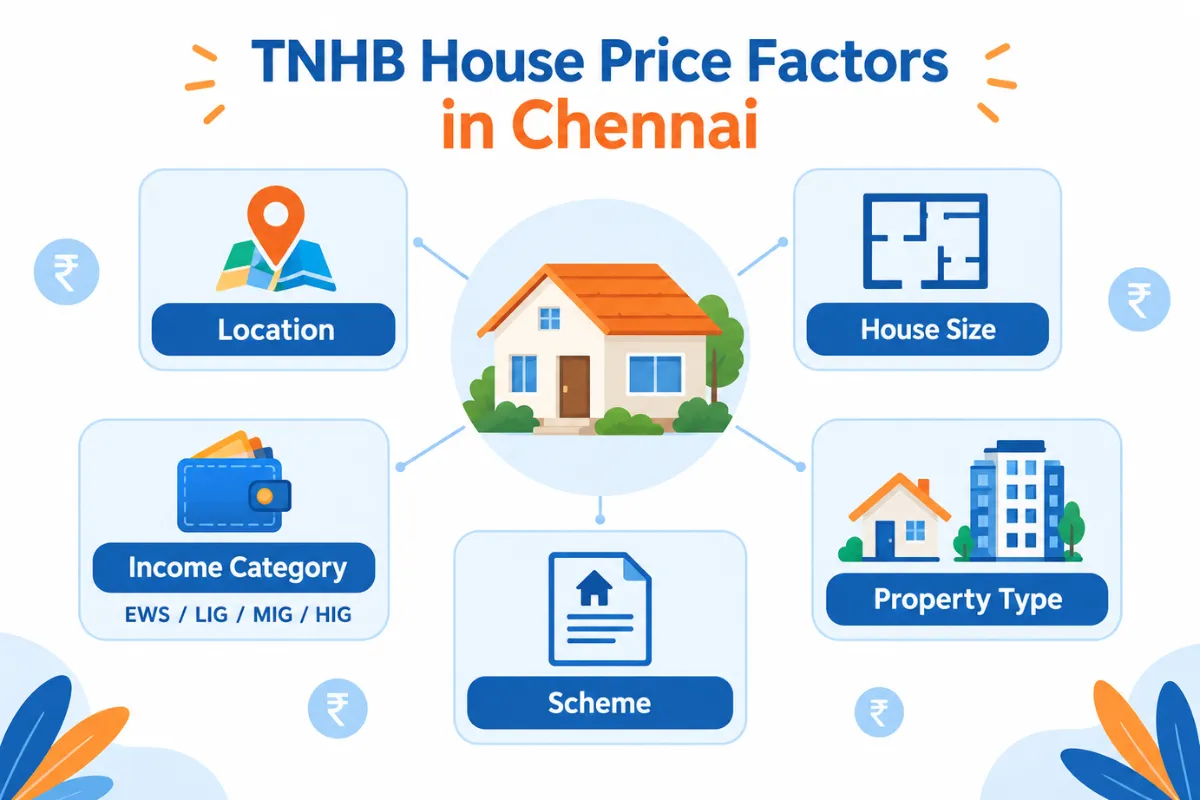
There is no single TNHB house price in Chennai for 2026 because TNHB sells different properties under different schemes. An apartment in one project can have a different price from a larger unit elsewhere. Location, unit size, construction cost, floor level, amenities, infrastructure and project-specific charges can all affect the final amount.
TNHB project records show this variation across Chennai. Projects in locations such as Sholinganallur, Koyambedu, Anna Nagar and Shenoy Nagar have differed considerably in size, unit type and overall project cost.
For 2026, buyers should avoid relying on old articles quoting one “TNHB rate” for Chennai. The more useful figure is the advertised price in the current notification for the specific unit or project.
Current TNHB Price Examples
Publicly available TNHB project documents demonstrate how project costs can vary. These figures are project-level costs rather than current selling prices for individual homes. They are useful for understanding the scale of different developments, not for estimating today’s buyer price.
| Chennai TNHB Project/Location | Units Mentioned in TNHB Records | Project Cost Mentioned |
|---|---|---|
| HIG flats, Anna Nagar West | 44 | ₹18.75 crore |
| HIG flats, New Tower Block, Nandanam | 102 | ₹41.47 crore |
| MIG flats, Dr. Ramasamy Salai | 120 | ₹43.75 crore |
| HIG flats, A.P. Patro Salai | 90 | ₹31.98 crore |
| MSB flats, Sholinganallur | 1,000 | ₹218.05 crore |
| HIG flats, SAF Games Village, Koyambedu | 418 | ₹177.47 crore |
| MSB flats, Shenoy Nagar | 240 | ₹98.80 crore |
| HIG flats, Anna Nagar | 72 | ₹30.63 crore |
These historical figures show why quoting a universal TNHB price can be misleading. The actual amount payable may depend on the current advertisement, unit size, construction stage, applicable taxes, registration costs and other charges.
Current notifications should therefore be checked before making a financial decision. TNHB notifications can specify available units, sale methods, prices, eligibility and application deadlines for particular projects.
TNHB House Prices by Income Category
Income category can influence eligibility, but there is no universal 2026 price automatically attached to EWS, LIG, MIG or HIG. Applicable income limits and property prices must be taken from the relevant scheme notification.
Broadly:
- EWS: Economically weaker-section housing.
- LIG: Lower-income-group housing.
- MIG: Middle-income-group housing.
- HIG: Higher-income-group housing.
Older allotment documents may contain historical income limits, but these should not be treated as current 2026 limits.
Factors That Affect TNHB House Prices
Several factors can change the price of a TNHB home:
- Location: Land values differ across Chennai.
- Unit size: Larger homes generally have higher total costs.
- Income category: Schemes may target different buyer groups.
- Construction specifications: Building materials and amenities affect costs.
- Development charges: Infrastructure and common facilities can add to the amount payable.
- Taxes and registration expenses: These may be additional to the base price.
- Project-specific conditions: Payment schedules and charges vary by notification.
Buyers should therefore calculate the total acquisition cost, rather than comparing only the headline property price.
Popular Areas for TNHB Houses in Chennai
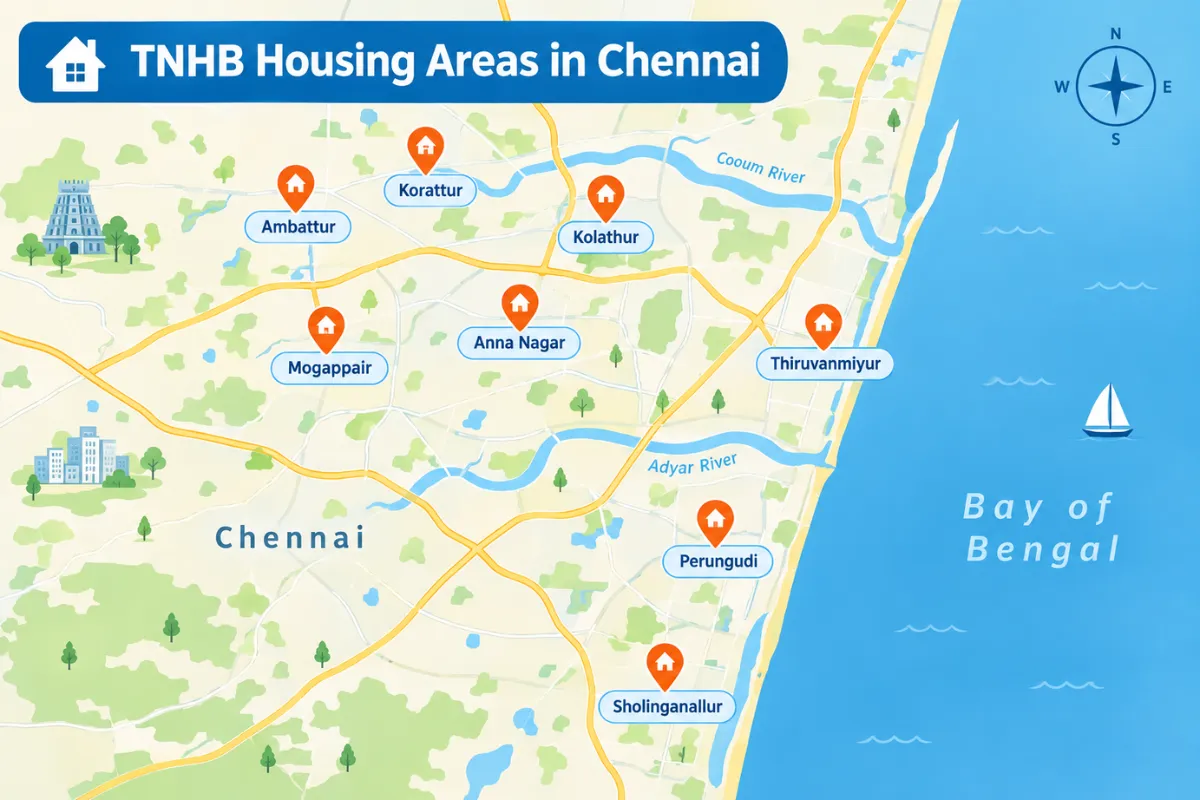
Location matters almost as much as the house itself. A TNHB property may suit a buyer differently depending on its access to workplaces, schools, hospitals, public transport and everyday facilities. Therefore, buyers should assess the neighbourhood along with the property and its official documentation. You can also explore best areas in Chennai to compare popular residential locations and their key features.
Mogappair and Nolambur
Mogappair and Nolambur are established residential areas in western Chennai with housing developments and TNHB-related properties. Their appeal includes established infrastructure and access to commercial and employment areas.
Buyers should distinguish between an original TNHB allotment and a resale property in a TNHB-developed neighbourhood. Documentation, transfer conditions and ownership history can differ considerably.
Sholinganallur
Sholinganallur is an important location when researching TNHB housing in Chennai. TNHB records include a major multi-storey flat project in Sholinganallur.
Its position along the OMR corridor makes it relevant to buyers working in technology and business districts. However, buyers should also evaluate traffic, commute times, public transport, schools and everyday infrastructure before purchasing.
Anna Nagar and Ayanavaram
Anna Nagar and Ayanavaram are established Chennai locations where TNHB has undertaken housing activity. TNHB records identify residential projects in Anna Nagar, while Ayanavaram has also featured in recent project planning.
For resale TNHB properties, buyers should pay attention to building age, maintenance, parking, redevelopment possibilities and the condition of common areas.
Other TNHB Locations Around Chennai
TNHB activity extends beyond central neighbourhoods. Official records identify development or project activity in Ambattur, Avadi and Sholinganallur, among other locations.
Depending on current notifications, buyers may also encounter properties or schemes around:
- Koyambedu
- Shenoy Nagar
- Nandanam
- KK Nagar
- Besant Nagar
- Ayanavaram
- Ambattur
- Avadi
Availability should not be assumed from an older project list. Current TNHB notifications are the reliable starting point for checking 2026 opportunities.
TNHB House Eligibility and Income Categories
Eligibility is one of the most important parts of buying a TNHB property. Not every TNHB home is available to every applicant. Eligibility can depend on the specific scheme, applicant category, income, existing property ownership and other conditions stated in the notification.
The Board’s online procedures may also require applicants to upload documents and obtain certificates from relevant authorities.
EWS, LIG, MIG and HIG Categories
TNHB housing has historically been divided into income categories, but exact limits can change through government orders and scheme-specific notifications. Therefore, older income thresholds should not be treated as current 2026 limits.
| Category | General Meaning | What to Verify in 2026 |
|---|---|---|
| EWS | Economically Weaker Section | Current income ceiling and scheme conditions |
| LIG | Lower Income Group | Current income ceiling and eligibility |
| MIG | Middle Income Group | Current income ceiling and scheme conditions |
| HIG | Higher Income Group | Current income ceiling and property eligibility |
The TNHB allotment manual contains historical income-limit orders, showing that these thresholds can change over time.
Who Can Apply for a TNHB House?
Eligibility depends on the particular scheme, but applicants should be prepared to establish their identity, income and other qualifications specified in the notification.
Typical requirements can include:
- Meeting the income category applicable to the scheme.
- Satisfying applicant conditions stated in the notification.
- Providing valid identity and address documentation.
- Producing income or category certificates where required.
- Meeting conditions concerning existing ownership or previous allotment.
- Completing the application and payment within the specified period.
Never assume eligibility from a general TNHB rule. Read the current notification before paying an application or booking amount.
Documents Required
The exact document list varies by scheme, but online applications can require documents such as:
- Identity proof.
- Address proof.
- Income certificate or income-related documentation.
- Category/certificate documents where applicable.
- Passport-size photograph.
- Bank/payment details.
- Other certificates specifically requested by TNHB.
TNHB may publish separate instructions for documents to upload and certificates to obtain from concerned authorities.
How to Buy a TNHB House in Chennai
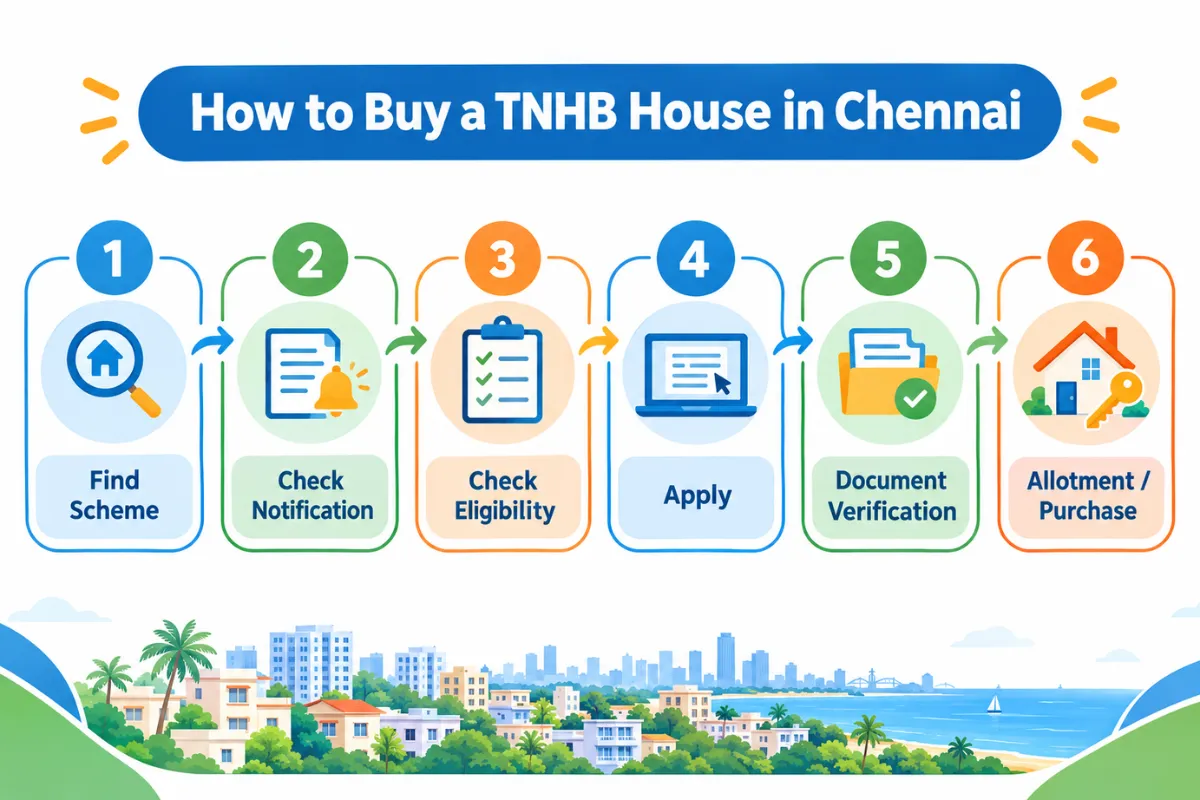
Buying a TNHB house is less like visiting a showroom and more like following a government housing process. First, identify an eligible scheme, study its notification, check the property and eligibility conditions, submit the application, make the required payment and then follow the allotment or booking procedure.
TNHB provides online housing-related services, including property booking, application status, lottery-related services and allottee services.
Check Current TNHB Housing Schemes
Start with the official TNHB notifications and project pages rather than relying only on property portals or advertisements. The notification page is useful for time-sensitive announcements, including FCFS sales and online application instructions.
Check:
- Project location.
- Unit type and size.
- Advertised price.
- Income category.
- Eligibility requirements.
- Application dates.
- Booking method.
- Payment schedule.
- Required documents.
- Transfer and registration conditions.
A notification is your roadmap. If an agent’s statement differs from the notification, carefully verify the written TNHB terms.
Online Booking and FCFS Process
Some TNHB properties are sold through First Come First Served (FCFS) arrangements. TNHB has published online booking instructions for FCFS sales, and certain notifications use this mechanism.
A typical FCFS process can involve:
Find the relevant notification. Identify the project and confirm that booking is open.
Read the eligibility conditions. Check income, documents and restrictions.
Register on the relevant TNHB online system. Use the official portal specified by the Board.
Complete the application details. Enter personal, contact and other required information accurately.
Upload the required documents. Follow the portal’s format and size requirements.
Select the available unit, if applicable. Availability may change during the booking period.
Pay the required amount. Use the payment method specified by TNHB.
Save the acknowledgement. Keep the application number, receipt and confirmation.
The sequence can differ between projects, so follow the current notification and project instructions.
Application, Payment and Allotment Process
After application or booking, the next steps depend on whether the scheme uses FCFS, lottery or another allotment method.
A buyer should generally:
Submit the application before the deadline.
Make the prescribed payment.
Retain application and payment acknowledgements.
Monitor application or allotment status.
Complete additional documentation when requested.
Pay instalments according to the prescribed schedule.
Complete registration and related formalities.
TNHB also publishes separate instructions for different allotment methods.
What Happens After Allotment?
After allotment, the buyer generally moves through payment, documentation and possession stages according to the project’s terms.
Keep records of:
- All payment receipts.
- Allotment letter.
- Agreement documents.
- Correspondence with TNHB.
- Possession-related documents.
- Registration records.
The allotment letter is not necessarily the end of the process. Understand the final ownership and registration requirements before treating the property as fully purchased.
TNHB House vs Private Property
A TNHB property and a privately sold property differ mainly in how the property is offered, documented and transferred. With a private property, the buyer typically deals directly with an owner or developer, subject to applicable laws, approvals and contractual terms. With TNHB, the property is connected to a specific Board scheme and may have scheme-specific allotment, payment and transfer conditions. Buyers comparing housing options can also explore flats for sale in Chennai to understand other residential property choices.
For a buyer, the practical differences can include:
- Pricing: TNHB prices are linked to the relevant scheme, while private properties may involve negotiation.
- Application: TNHB properties can require formal applications and online procedures.
- Allotment: Some properties may be allotted through lottery or FCFS mechanisms.
- Documentation: Scheme, allotment and ownership records are important.
- Transfer: TNHB properties may have conditions affecting transfer, depending on the scheme and documentation.
- Resale: A resale TNHB property requires careful examination of the original allotment, sale deed and subsequent ownership documents.
Recent Madras High Court cases also highlight the importance of checking TNHB sale deeds, lease-cum-sale agreements, additional payment demands and registration matters before completing a transaction.
Things to Check Before Buying a TNHB House

A TNHB property can look straightforward, but its paperwork deserves as much attention as the building. Before committing money, verify the scheme, ownership documents, payment position and transfer conditions. For a better understanding of the documentation involved, you can also refer to property ownership in Chennai.
Verify TNHB Scheme and Allotment Details
Confirm that the property genuinely belongs to the TNHB scheme claimed by the seller. Match the property with the allotment letter and relevant TNHB records.
Check:
- Scheme name.
- Block and flat/house number.
- Original allottee.
- Allotment date.
- Sale consideration.
- Payment status.
- Possession status.
- Outstanding TNHB requirements.
For resale properties, request the complete chain of ownership documents.
Check Property Documents and Ownership
Have the documents reviewed by a qualified property lawyer where appropriate. You can also refer to property tax in Chennai to understand the applicable property tax details.
Look for:
- Original allotment documents.
- Agreement or lease-cum-sale documents.
- Registered sale deed, if applicable.
- Previous transfer documents.
- Encumbrance-related records.
- Property-tax records.
- Approved plans where relevant.
- Required TNHB permissions or NOCs.
Court proceedings involving TNHB properties demonstrate why sale deeds, transfer rights and allotment conditions should be examined carefully.
Inspect Location, Construction and Amenities
Visit the property before purchasing rather than relying only on advertisements.
Check:
- Building condition.
- Water and electricity supply.
- Roads and access.
- Parking and lifts.
- Common-area maintenance.
- Drainage and sewage.
- Nearby schools and hospitals.
- Public transport.
- Traffic and noise.
- Flooding or waterlogging history.
For older TNHB properties, construction condition can significantly affect ownership costs.
Check Outstanding Dues and Transfer Conditions
Before paying the seller, verify whether any amounts remain payable.
Confirm:
- TNHB instalments are cleared.
- Maintenance dues are cleared.
- Property tax is paid.
- Utility bills are settled.
- Required NOCs are available.
- Transfer restrictions are satisfied.
- Registration requirements are understood.
- No unresolved disputes affect the property.
Scheme-specific legal and payment conditions should always be verified before completing the transaction.
Frequently Asked Questions
What is the price of a TNHB house for sale in Chennai in 2026?
There is no single TNHB house price in Chennai in 2026 because prices vary between housing schemes and locations. The final cost can depend on the property type, unit size, income category, construction specifications, development charges and other applicable costs. Buyers should check the latest TNHB notification for the specific project’s advertised price and payment schedule rather than relying on older price information.
Which areas have TNHB houses for sale in Chennai?
TNHB has developed or undertaken housing projects in several Chennai locations, including Sholinganallur, Anna Nagar, Koyambedu, Shenoy Nagar, Ayanavaram, Ambattur and Avadi. Different projects may offer flats, apartments, houses or other residential units. Availability changes as new notifications are issued and existing units are allotted or sold, so buyers should verify the current project and location details through official TNHB sources.
Who is eligible to buy a TNHB house in Chennai?
Eligibility depends on the individual TNHB housing scheme and its current notification. Applicants may need to meet specified income-category requirements and provide identity, address, income and other supporting documents. Some schemes can also include conditions relating to existing property ownership, previous allotments or applicant status. Because income limits and conditions can change, buyers should check the notification applicable to the property they want to purchase.
How can I apply for a TNHB house in Chennai?
To apply, first identify an available TNHB scheme and read its notification carefully. Follow the prescribed online application or booking procedure, submit the required information and documents, and make the specified payment within the deadline. Depending on the project, properties may be offered through First Come First Served (FCFS), lottery or another allotment method. Applicants should retain their acknowledgement and payment records.
What should I check before buying a TNHB resale house?
Before buying a resale TNHB property, verify the original allotment, registered sale deed, ownership chain, payment status and property-tax records. Also check outstanding dues, transfer restrictions, required TNHB permissions or NOCs and registration requirements. Inspect the property’s physical condition and confirm that the seller’s documents match the actual property. For significant transactions, consider having the documents reviewed by a qualified property lawyer.
Conclusion
A TNHB house for sale in Chennai can offer different housing formats, locations and income categories, but no single price or eligibility rule applies to every property. In 2026, TNHB continues to publish housing notifications, online application instructions and FCFS opportunities, making the official Board website an important source for checking current availability.
If you’re planning to buy, begin with the latest notification, understand the total cost, confirm your eligibility and inspect the property and documents carefully. Whether you choose a new TNHB unit or a resale property in a TNHB-developed area, verify ownership, transfer conditions, outstanding dues and registration requirements before completing the purchase.